
Finding Monroe Residents Through Records
Monroe County does not maintain one open roll of every person who lives here. Instead, the County Clerk records land and court filings, Real Property Tax Service maintains assessment material, the Board of Elections runs a current-status lookup, and Rochester Public Library preserves historical directories. Each source has a different purpose. A recorded deed can establish an ownership event. A directory can show that a name was printed at an address in a particular year. Neither result alone proves continuous residence.
Use a narrow, documented trail. Keep the spelling, municipality, date, and source with each result. For a present-day address, start with the parcel or property record. For a historical household, start with an address directory or archive collection. For a court or vital event, use the appropriate custodian rather than asking a different office to recreate a record it does not keep.
- Normalize the supplied name or address, including the municipality and ZIP code.
- Check the Monroe County Real Property Tax Service route for the parcel, owner role, tax information, and SBL identifier.
- Use the Clerk's land-records route and IQS index to follow a recorded transfer.
- For a known person and current address, use the Monroe voter lookup only to verify the current election relationship.
- For an older household, inspect Rochester Public Library city and house directories, then preserve the volume and page.
Note: Keep a retrieval date because portal access, election information, and document-image availability can change.
Monroe Residents Records Offices
Three county offices answer most current address questions, but they do not hold the same evidence. The Clerk is the County Registrar and records deeds, mortgages, liens, judgments, maps, and related filings. Real Property Tax Service holds assessment rolls, tax maps, title-change processing, and property information. The Board of Elections provides a current voter-registration and polling lookup. The right office depends on whether the question concerns an ownership event, a parcel, or a current election status.
Monroe County Clerk
County Office Building
39 W Main St, Room 101/105
Rochester, NY 14614
585-753-1600
Real Property Tax Service
304 County Office Building
39 W Main St
Rochester, NY
585-753-1125
Monroe County Board of Elections
435 Smith St
Rochester, NY 14608
County elections office
The Clerk also accepts counter, phone, fax, mail, and online request routes. Real Property Tax Service gives a parcel and assessment starting point, while the county GIS map provides the location context. Election data has separate confidentiality rules and is not a street-by-street resident roll.
Monroe Parcel Keys for Residents
A property search begins with a physical location, yet the fields describe different things. The situs address is the parcel location. A mailing address can belong to the person who receives tax material. The SBL, or section-block-lot identifier, is the local parcel key that helps connect a map result with assessment and deed research. The Monroe County Parcel Viewer supplies parcel, boundary, and ZIP-layer context, but a map label is not a finding that someone occupies the parcel.
- Parcel
- A defined piece of land recorded for tax and mapping purposes.
- Situs address
- The physical address tied to the parcel, distinct from a tax mailing address.
- Index
- A finding tool that points to a record; it is not always the document image.
- Criss-cross directory
- An address-first directory that can be paired with an alphabetical listing.
The county's ZIP layer can be identified and queried in the GIS services but is marked not searchable in the viewer. Use the map to narrow the area, then confirm an exact postal assignment through USPS ZIP Lookup. A postal city, municipal boundary, neighborhood, and parcel are separate geographic labels.
Monroe Deed Records Have a 1975 Split
The Clerk's historical property guide uses 1975 as the practical divide for a backward deed search. For later material, search the digital land system by property address or owner, open the oldest available deed, and capture the recording date, liber and page, grantor, grantee, and legal-description clues. The earliest grantor then becomes the next name to check as a grantee. That is the county's documented method for moving backward through recorded transfers.
Earlier work moves to microfilm at the Downtown Filing Office, first-floor Room 105. Choose film by liber and locate the page. When an older index entry lacks a liber and page, the guide directs researchers to use the transfer year and the grantee surname initial in index books. Transactions before Monroe County formed in 1821 can lead to Ontario or Genesee County material held on microfilm. That boundary change is a research instruction, not a dead end.
A March 2026 Clerk release says standard IQS index information remains free while digital document images require a subscription beginning April 1, 2026. The release did not give prices. Public-terminal, microfilm, copy-order, and subscription availability should be checked for the exact document.
See the Monroe IQS entry point before starting a name, document, or address search.
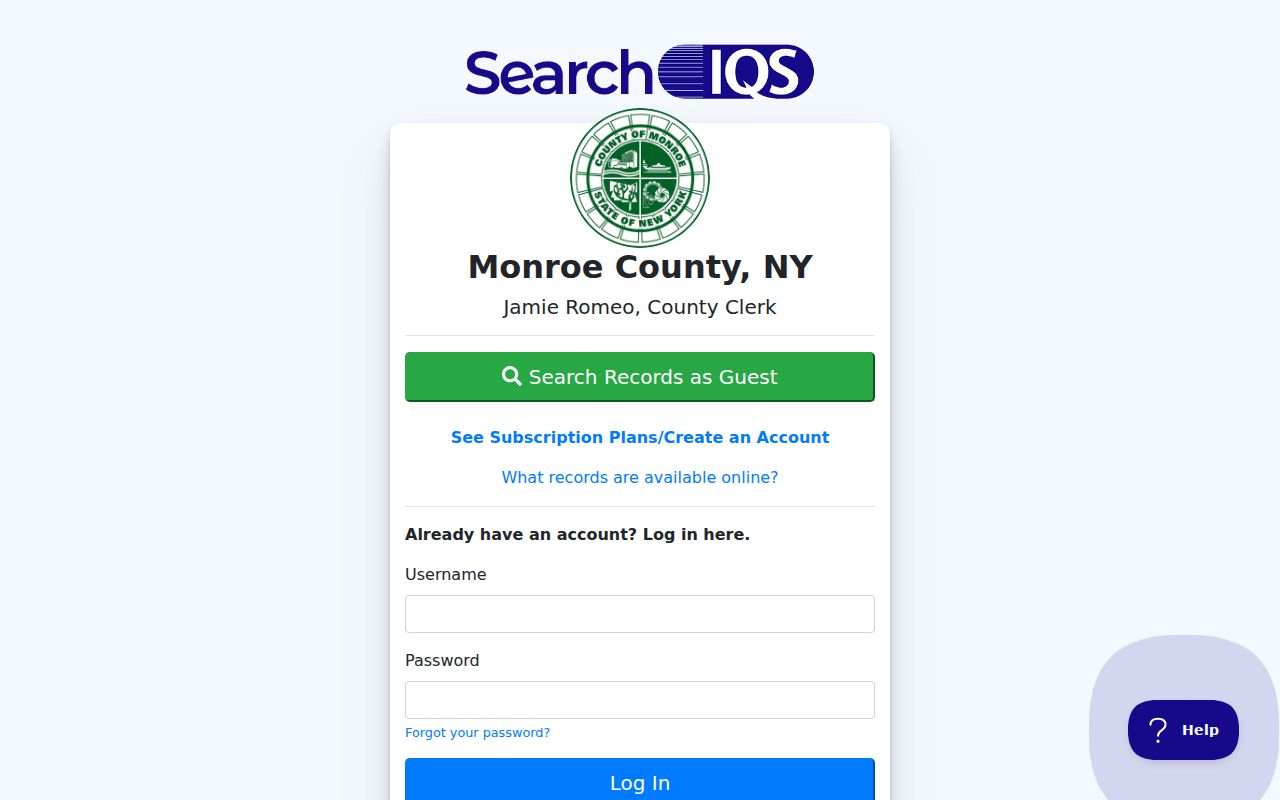
The screenshot shows the discovery route for the Clerk's index. It does not promise that every matching document image is free or available online.
Current Monroe Residents Directory Sources
Current Monroe residents directory work is a comparison of roles, not a single list. The property route is strongest for an assessed parcel or recorded owner. The voter tool is a current registration and polling check for an address and person already known. Clerk indexes show parties to a filing. Court and licensing indexes answer still other questions. Keep the source role next to the name so a mailing recipient, grantor, court party, or licensee is not relabeled as a resident.
| Monroe source | Signal returned | Custodian | Access route |
|---|---|---|---|
| Real Property portal | Parcel, assessment, owner or mailing context | Real Property Tax Service | Property page and portal |
| Voter lookup | Registration, polling, ballot status | Board of Elections | Known person and address query |
| IQS land index | Parties, document, recorded-transfer trail | County Clerk | Index, counter, request, or microfilm |
| WebCivil and WebSurrogate | Public case or estate filing | New York courts | Correct court index or clerk |
| NYSED verification | Public credential and status | New York State Education Department | Official license search |
Official sources are preferable to commercial people-finder categories because the custodian, date, and record role can be checked. A private compilation can be stale, combine namesakes, or blur an old address with a current one. It should never replace the original Monroe record.
Monroe Election Lookup Fields
The Monroe County voter lookup is designed for a specific current query. Its observed controls are Street #, an autocomplete Street Name, Zip Code, Last Name, Date of Birth in MM/DD/YYYY form, and Search. Results can include registration status, an Election Day polling place, sample ballot, absentee or mail-in status, and elected officials. Required markers and static result labels were not exposed during research, so check the live screen.
| Field | Use in a Monroe query |
|---|---|
| Street number and street name | Use the normalized address selected by the tool. |
| ZIP code | Compare it with USPS and GIS when boundaries differ. |
| Last name and date of birth | Use only when authorized; do not publish protected identifiers. |
| Result date | Record the election cycle because polling information changes. |
Visit the official voter lookup before relying on current-cycle information.
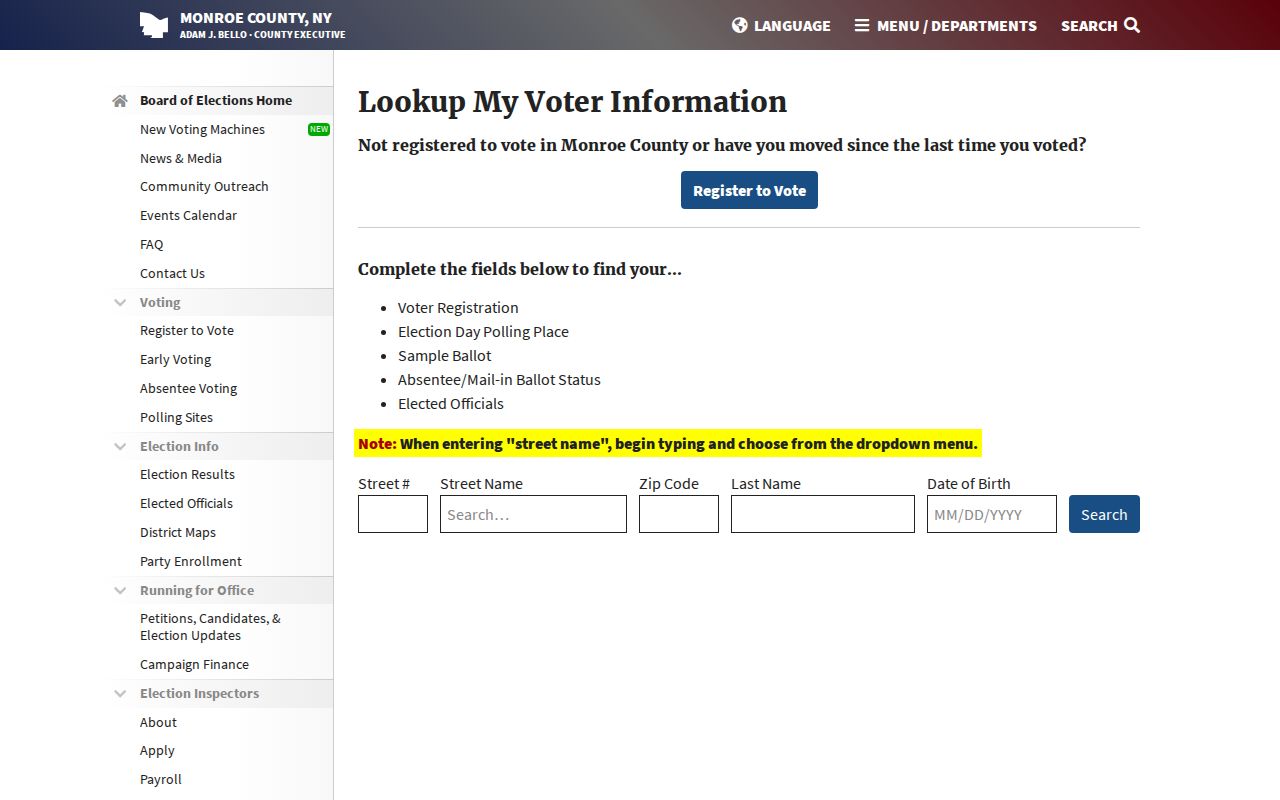
This interface confirms why street spelling, ZIP, and election date belong in a careful Monroe record note.
Note: Confidential registrations under New York Election Law §5-508 are separately handled and must not be reverse-located.
Monroe Court Names Need Context
For a public court matter, begin at Web eCourts and select the service that fits the case. WebCivil Local searches participating local civil cases by index number, party, attorney, judge, court, and calendar. WebCivil Supreme covers active and disposed Supreme Court civil cases. WebCriminal, WebFamily, eTrack, and WebSurrogate serve different court functions. Monroe Surrogate public index links cover 2012 through 2026, while WebSurrogate provides name, file, old-index, index-book, and will-search modes.
A no-hit only means the item was not found in that index. Sealed matters, youthful-offender cases, adoptions, Article 81 matters, data lag, limited local-court coverage, and cases with no future appearance can be absent. A party name establishes a public filing role, not an address, a finding of guilt, or an identity match by itself.
Monroe Vital Records Use Separate Doors
Monroe County Vital Records handles local birth and death records from 1880 forward through appointment, online order, mail form, and genealogy application routes. Eligibility for a current certified copy is narrower than a historical search. New York State genealogy rules generally use 75 years for births, 50 years for deaths, and 50 years for marriages when both parties are deceased, with proof and direct-line exceptions. Marriage records route through the issuing city, town, or village clerk; the state holds divorce certificates from 1963 forward.
Use the county's online birth and death order route only when the eligibility terms fit the request. Its result is not a public name directory.
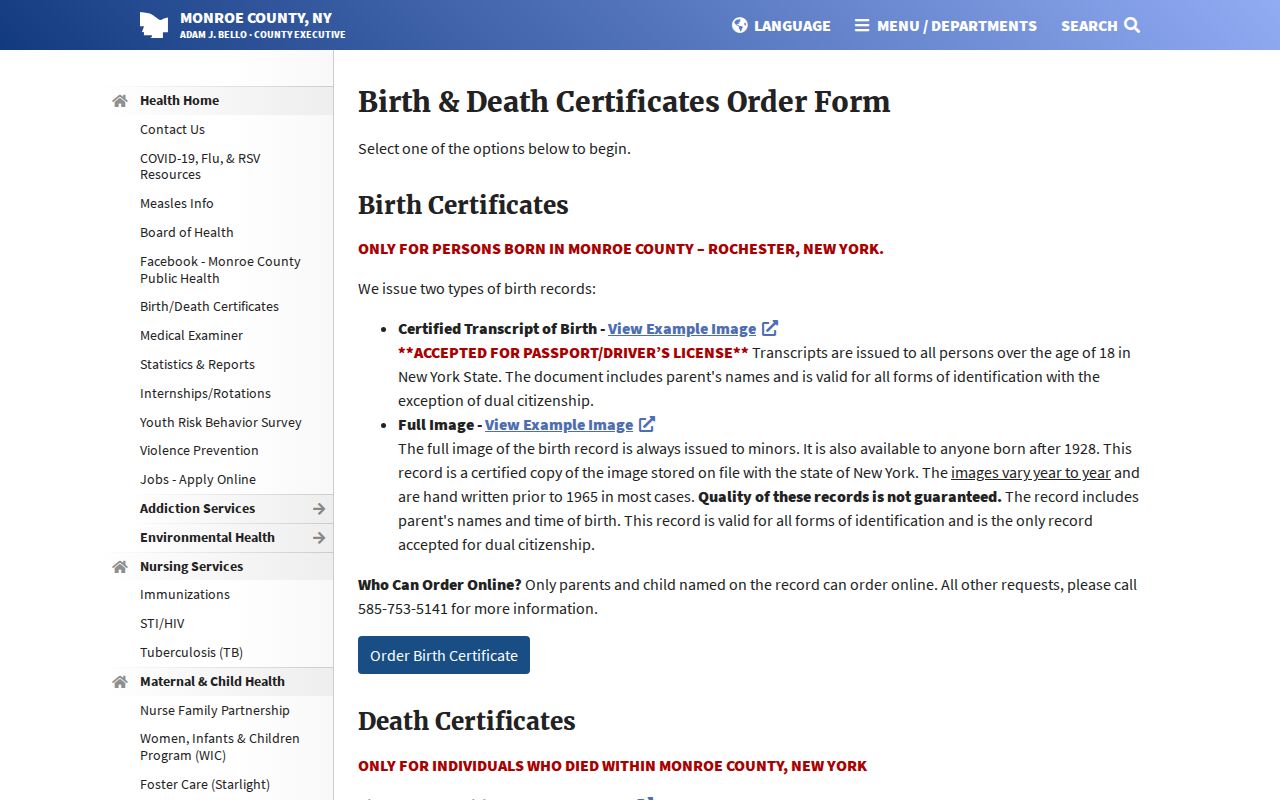
The official ordering screen reinforces that relationship, document type, and application rules control access to vital material.
Monroe Historical Residents Directory Shelves
Rochester Public Library's city directory collection begins with bound volumes from 1827. Its 15-volume Rochester House Directory is organized by street address from 1892 through 1920, and house-directory material appears at the back of the main directory beginning in 1922. The library also identifies suburban directory coverage for Brighton, East Rochester, Fairport, Gates, Greece, Irondequoit, Pittsford, and Webster from 1930 through 1940.
Digitized volumes are page scans, not a complete searchable name index. Search the alphabetical entry, inspect the house section, and try an earlier street name or nearby number before concluding a name is absent. The complete collection method belongs on the Monroe city directories page; a result should retain the directory year, publisher, volume, and page.
Rochester Municipal Archives adds field assessment cards from 1927 to 1980 that can include previous owners or residents, drawings, and photographs. Its appointment route, not walk-in browsing, is the appropriate access path for that local series.
Monroe FOIL and Custodian Requests
New York's Freedom of Information Law, Public Officers Law §§84-90, applies to existing agency records subject to exemptions. The Monroe County FOIL route asks a requester to reasonably describe the record. The Records Access Officer may grant, deny, or acknowledge the request within five business days and provide an approximate response date. A denial can be appealed within 30 days.
FOIL is not the route for court files. Court searches and copies are governed by Judiciary Law §255 and should go to the relevant clerk. An agency does not have to create a custom resident list, answer an open-ended question, or reconstruct information it does not maintain. The County FOIL page is the source for its online and printable request channels.
Use the county's official request information before submitting a records request.
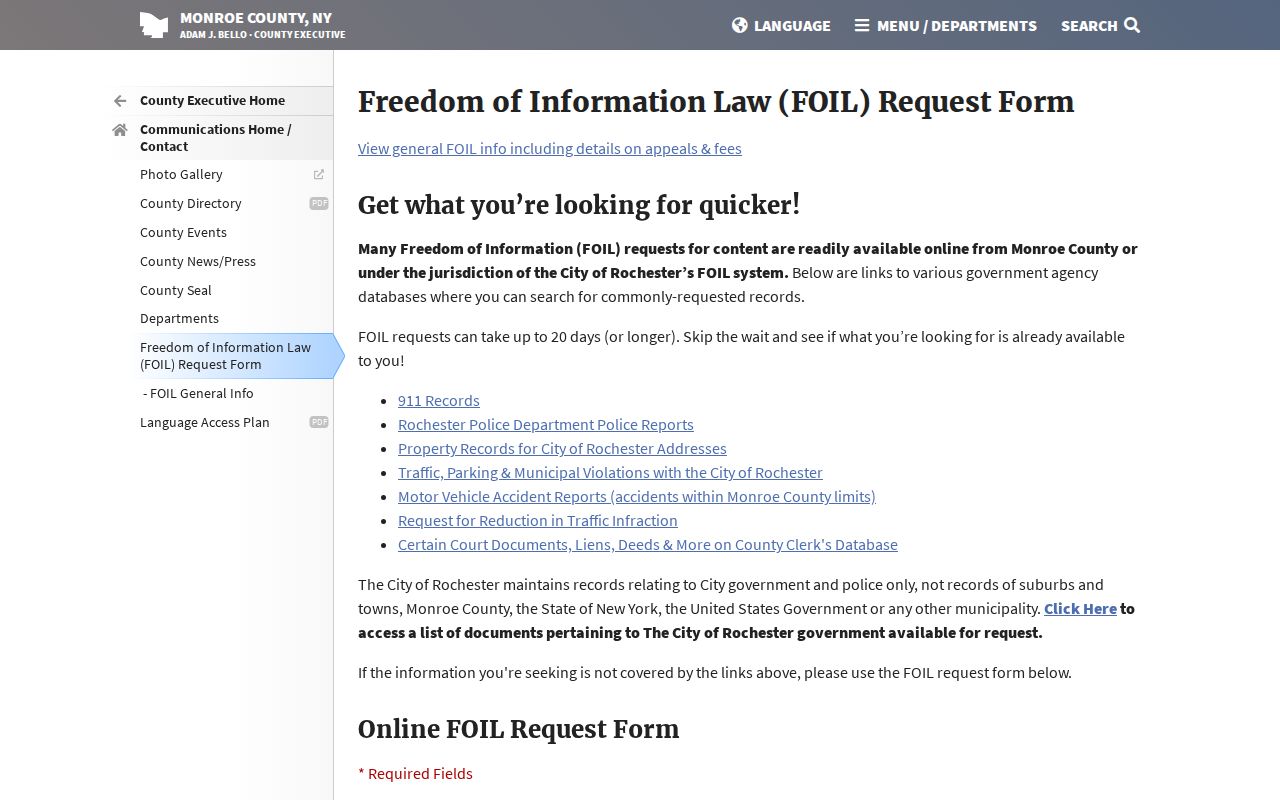
The request route is useful when a known record exists but the public portal does not expose the needed copy or index detail.
Monroe Public Status Searches Need Dates
Some official name searches answer a narrow public-status question rather than a residence question. The New York sex-offender registry accepts one search mode at a time: last name, county, or ZIP, with choices to exclude some custody categories. Its web results cover level 2 and level 3 information. Level 1 information has a separate telephone channel. A registry result must be checked at the official source, dated, and never used to threaten, harass, or discriminate.
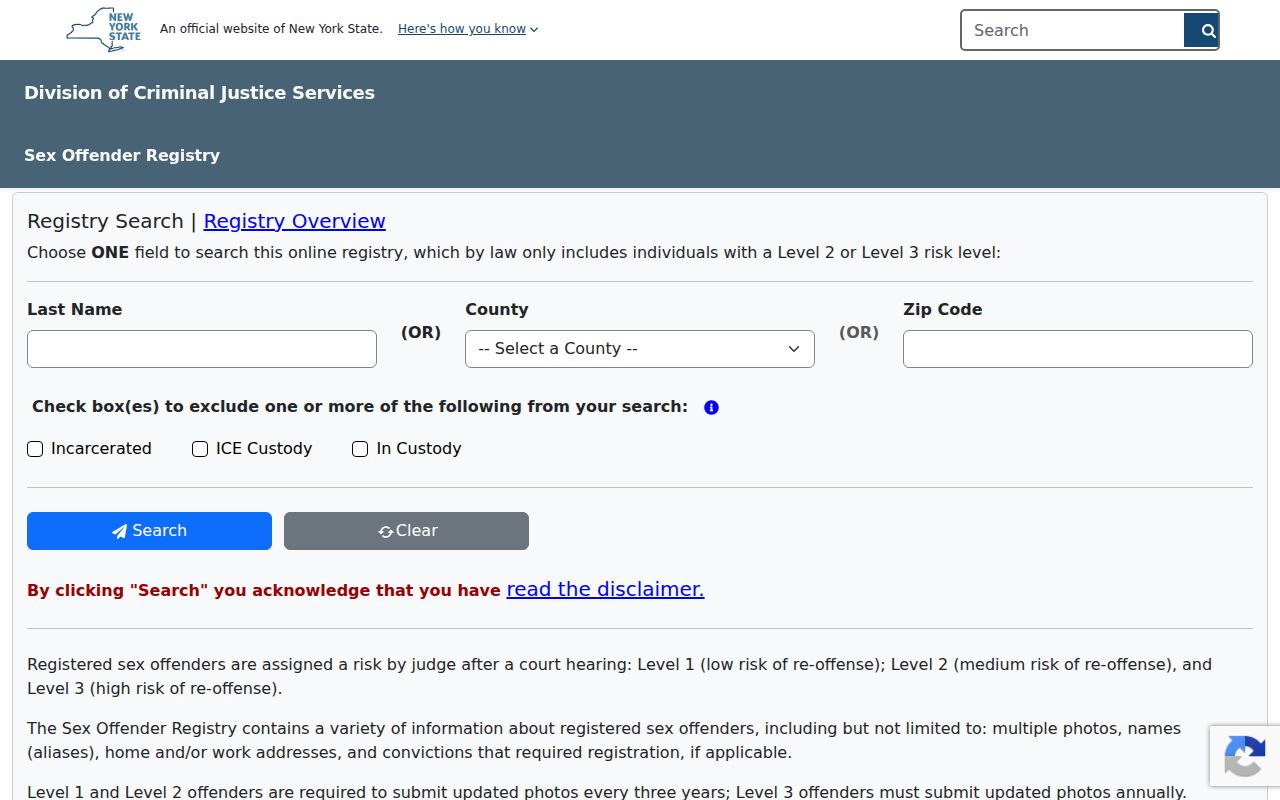
The official form makes clear that county and ZIP are controlled search filters, not confirmation that a person lives at a particular address.
For a credential question, use the NYSED verification search by profession, surname, or license number. A public practice or business location confirms the displayed credential relationship, not a private address.
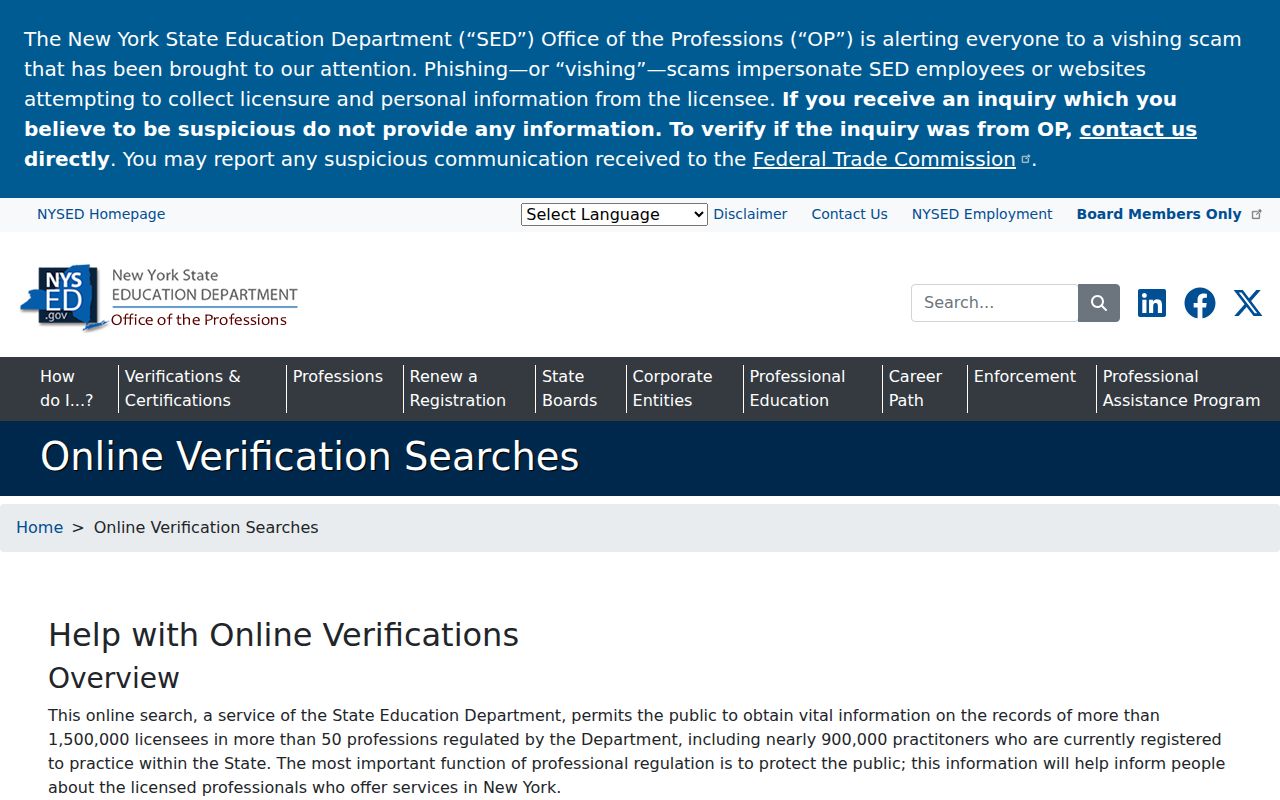
Credential status, name spelling, license type, and lookup date belong in the research note when a Monroe name is common.
Monroe Privacy Limits on Names
Some Monroe records are public while others are deliberately protected. New York's Address Confidentiality Program provides a legal substitute address for eligible participants, and public agencies must follow the substitute-address rules. Confidential voter registrations, sealed court and adoption records, and restricted vital records are separate limits. An absent result can reflect a protection rule, a coverage gap, or a spelling problem. It is not permission to look for the person's actual address somewhere else.
Public-safety indexes also need care. A jail census, state custody lookup, or registry status is time-specific and does not create a full identity or conduct history. Consult the official source, preserve the date, and do not make conclusions beyond what the source states.
When an official record appears wrong, start with the custodian that created or maintains it. A County Clerk index, assessment card, voter registration record, court file, library scan, and private compilation have different correction paths. Preserve a copy or citation of the displayed error, identify the source date, and ask the responsible office about its correction or access procedure. Do not use a matching result from another database to overwrite a disagreement. A good Monroe research note records the conflict, the office contacted, and the next source that could resolve it.
See the official New York Address Confidentiality Program information for the safety route and its confidentiality rules.