
Monroe City Directory Collections by Era
Rochester Public Library holds the core Monroe city directory shelf. The collection begins with an 1827 volume and continues through later annual directories. It includes alphabetical volumes, a dedicated house-directory run, regional directories, and related newspaper and map material. Many online copies are page scans rather than a complete name index, so a search box may not find every printed entry. The library's original volumes are noncirculating, and fragile material can require staff help or a scan request. Record the title, year, publisher, page, and whether the entry came from a name or address section before drawing a conclusion.
| Collection | Years or format | Where held | How to use it |
|---|---|---|---|
| Rochester City Directories | 1827 onward collection | RPL Local History, selected scans, and a FamilySearch viewer | Read alphabetical names and addresses; scans may need page-by-page review. |
| Rochester House Directory | 1892-1920, 15 volumes | RPL | Browse from a street address to an occupant listing. |
| Main directory house section | 1922 onward | Back of the main directory | Compare the alphabetical entry with the address section. |
| Suburban directories | 1930-1940 named series | RPL regional collection | Check the right municipality and volume by year. |
| Newspaper and life-record indexes | Index and database coverage varies | RPL databases and index room | Use the cited issue or current database scope to test a trail. |
The Rochester City Directories collection is the first catalog to check. When a scan or volume is unavailable, the RPL Local History & Genealogy desk can route a reader to the physical shelf, microform, or another local collection.
Note: A Monroe directory entry identifies what its compiler printed for that year, not a certified or complete list of everyone at an address.
Monroe City Directories Before Incorporation
The earliest Rochester directory in the collection predates the city's 1834 incorporation. That timing matters. A person can appear under an early village-era description before later city street records or a modern postal form existed. Monroe County itself formed in 1821, and the Erie Canal reached Rochester in 1823. Those overlapping dates explain why a deed, directory, and municipal street source may use different place language for the same broad area.
- 1821: Monroe County forms from parts of Genesee and Ontario Counties.
- 1827: The Rochester directory collection begins.
- 1834: Rochester is incorporated as a city, and city council records begin.
- 1834-1921: The municipal Register of City Streets records openings, dedications, and name changes.
Use the sequence as a date check, not as a shortcut. An early city directory may point to a former street label, while the Rochester Municipal Archives street register can help normalize it. No comprehensive citywide renumbering schedule was located in the official research, so cross streets, lot descriptions, plats, and municipal boundaries remain important.
Monroe City Directory Shelves at Rundel
RPL's Local History & Genealogy unit is on the second floor of Rundel Memorial Library, 115 South Avenue. Its materials are noncirculating. Walk-ins can ask quick questions, while appointments are recommended, particularly when a fragile directory or a map needs staff handling. The room also provides a useful companion shelf: the Rochester Newspaper Index for 1818-1897, historical newspapers, census access, local tax and election material, maps, and Rochester Voices.
RPL Local History
Rundel Memorial Library, second floor
115 South Avenue, Rochester
585-428-8370
lochist@libraryweb.org
Municipal Archives
414 Andrews Street, Rochester
Genealogy appointments: 585-428-7331
Online Records Access Application first
Copies: 25 cents per page
For a concrete digital record, the 1971 Rochester directory viewer identifies R.L. Polk & Co. as publisher, Rochester Public Library as owner, and an extent of roughly 2,000 pages. The inspected viewer did not expose a stable readable individual entry. Treat it as a bibliographic and page-image route, not a promise of searchable text.
Reading a Monroe City Directory Entry
Read each Monroe city directory entry as a snapshot made by a particular compiler. The strongest notes preserve exactly what appears on the page: printed surname and given name, house number and street, apartment or room if shown, household or business designation, any cross-reference, directory year, page, volume, and publisher. A neighboring name can be useful for checking that the page and address are right. Do not invent an entry form from a later volume, because titles and sections change over time.
| Printed name | Copy spelling as printed, then note variants separately. |
|---|---|
| Street address | Capture the number, street, unit or room if printed, and old spelling. |
| Household label | Record a householder, boarder, or similar label only when the volume shows one. |
| Cross-reference | Follow it to the related name or address entry and save both page citations. |
| Volume detail | Keep the directory year, publisher, page, and whether it is alphabetical or address-first. |
- Criss-cross directory
- An address-first section that organizes listings by street and number rather than surname.
- Householder section
- A part of a directory that groups people or listings around an address. Its labels vary by volume.
- Abbreviation key
- The volume's explanation of its own marks and short forms. Save the key before interpreting a notation.
A missing name has several possible explanations. The compiler may have missed it, the person may have been a minor or had no fixed address, the property may lie beyond that directory's boundary, or the street name may have changed. Absence is not proof that a person was never in Monroe.
Monroe City Directories Beyond Rochester
City limits shape every Monroe city directory search. RPL also identifies directory runs for Brighton, East Rochester, Fairport, Gates, Greece, Irondequoit, Pittsford, and Webster from 1930-1940. A household just outside Rochester can disappear from a city volume while remaining present in a suburban directory. Confirm the exact volume and year with the library because not every fragile item has a scan.
The address-first house-directory route is especially useful here. Rochester's 15-volume House Directory covers 1892-1920 by street address. From 1922, house-directory material moved to the back of the main directory. Search the alphabetic name entry, then the relevant house section, and keep the city or town boundary in the research note. Modern street-by-street records are a separate route for current parcel work.
Maps Clarify Monroe City Directory Addresses
Historic maps can make a Monroe city directory address usable when a street label or number no longer fits the modern grid. RPL and local collections identify plats and maps from 1875, 1888, 1900, 1910, 1918, 1926, and 1935. The Library of Congress provides a free Rochester Sanborn volume for 1911-1912, with 118 images. Sanborn sheets show structures, uses, and street layouts. They do not name residents.
The Municipal Archives image route deserves special attention. Its field assessment cards cover 1927-1980 and can include prior owners or residents, drawings, and photographs. The Municipal Archives access page explains the appointment-based route.
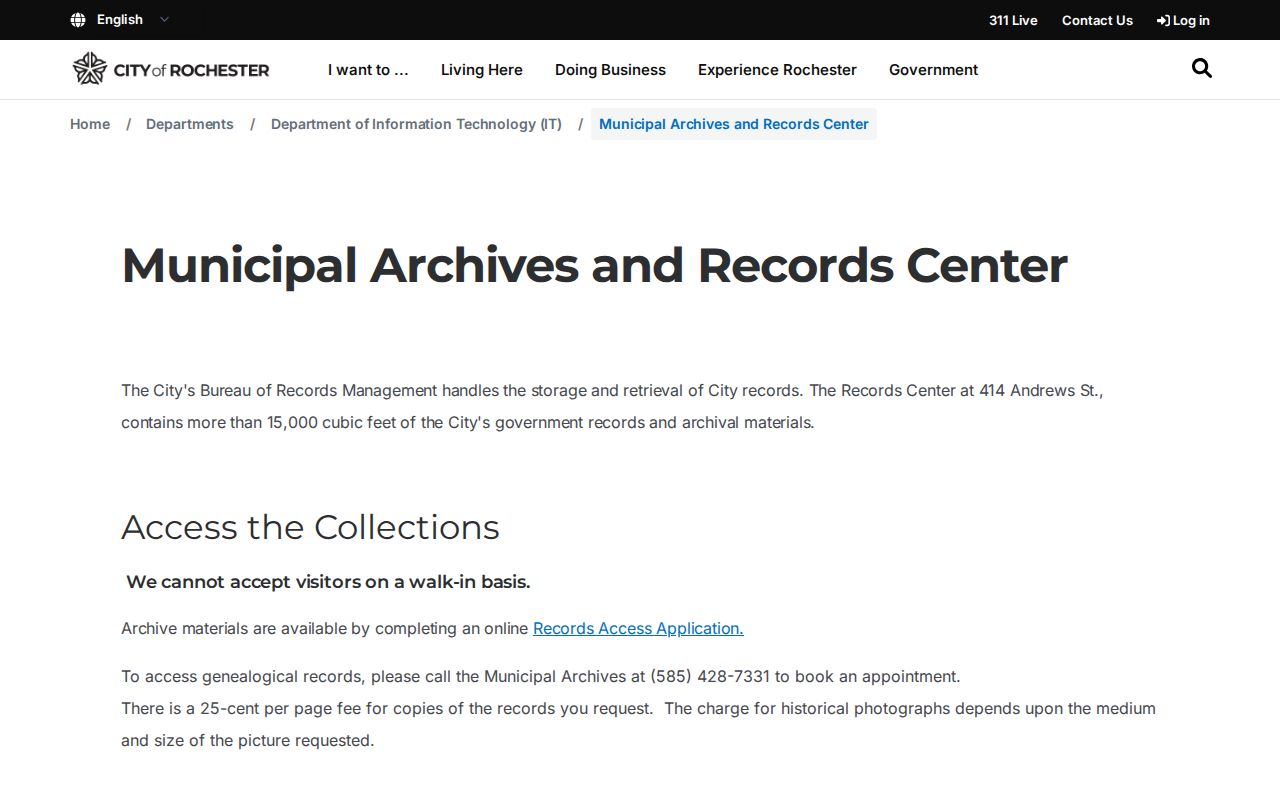
That archive is not a walk-in browsing room. The image reinforces why an appointment and a precise series request matter when a Monroe city directory trail reaches field cards or the city street register.
Note: A map sheet can confirm a street pattern or building context, but it does not establish who lived at the property.
Trace Families Through Monroe City Directories
To trace a household, move in small, dated steps. Begin with the directory closest to a known event or census year. Search the house-directory volume when the address is known, then check the alphabetical section for every spelling that appears. Pair each occupied address with the matching census, a deed role, a newspaper notice, or an assessment card. The point is to distinguish a printed listing from ownership, mail receipt, or a later family recollection.
- Write down the current or historic address, municipality, and any older street name.
- Locate the nearest house-directory or main-directory year and save the page citation.
- Check the alphabetical entry for spelling variants and cross-references.
- Move year by year, noting address changes instead of assuming one continuous household.
- Pair the dated listing with a census, deed, assessment card, or newspaper notice.
RPL's newspaper resources can close a trail, but their access and date ranges differ by title. The Life Records descriptions on official library materials do not give the same date span, so use the live database scope and ask staff when the interval matters. A present-day record still needs its own verification; a resident lookup can provide a separate, current record path.
Limits in Monroe City Directory Evidence
A city directory is strongest when it is part of an evidence chain. Keep the original spelling, page image, title, year, and collection location. Compare the address against the municipal street register when a road was renamed, and compare a legal parcel description when numbering looks wrong. Do not turn a directory listing, an archive image, or a business advertisement into a claim about a person's full history.
For family history, estate questions, and personal archival research, keep each record's role clear and treat private or restricted material with care. Never use a historical address trail to harass, track, or harm a living person.