
Previous Residents at a Monroe Address
Monroe address history works best as an era-by-era record trail. Start with the current parcel and use the County Clerk for recorded transfers. Then use Rochester directories and archive material to look for people connected to the address. Older land work can require a different county name because Monroe County was formed in 1821. No single result proves every part of a household's connection to a property, and the sources below should be read for the role they actually document.
| Source | Years it covers | Where held | What it shows |
|---|---|---|---|
| Predecessor-county land records | Before February 23, 1821 | County Clerk microfilm of Ontario and Genesee material | Earlier grantor and grantee transactions. |
| Monroe County Clerk land records | 1821 onward; digital guide uses a 1975 divide | Clerk, IQS, microfilm, and index books | Transfers, legal descriptions, instruments, and recording dates. |
| Rochester City Directories | 1827 onward collection | RPL | Alphabetical names, addresses, and household sections. |
| Rochester House Directory | 1892-1920 | RPL | Street-first occupants, householders, and boarders. |
| Rochester field assessment cards | 1927-1980 | Municipal Archives | Prior owners or residents, drawings, photographs, and assessment context. |
| Maps and aerial records | Sanborn 1911-1912; aerials from the 1930s | Library of Congress and County GIS Records | Structure, street, and building context rather than resident names. |
Choose the starting source by the question. A transfer date calls for the Clerk. A household question calls for a directory or field card. A street mismatch calls for the city street register, plats, or Sanborn maps. This distinction keeps a Monroe previous residents search from turning a mailing address or a legal role into an unsupported claim.
Set the Monroe Address and SBL
Freeze the present-day location before looking backward. Save the situs address, municipality, postal ZIP, map date, and SBL or tax-map identifier. An SBL is the parcel identifier used in the local property and assessment workflow. It is more stable than a street number when a road changed name, a parcel was divided, or a description uses a lot rather than a modern address.
The Monroe Real Property Tax Service maintains assessment rolls, tax maps, title-change processing, and subdivision records. Its public portal is the property-information, tax, and historical-sales entry point. Keep a property owner and tax mailing address in separate columns from the situs address. A tax recipient, a deed's return address, and a person listed in a directory may each describe a different relationship to the parcel.
Monroe Previous Residents After 1975
The County Clerk's historical guide treats 1975 as the practical break between the digital route and the older microfilm route. For later material, search by the property address or a party name in the land system, open the oldest available deed, and save the recording date, grantor, grantee, liber and page, legal description, and image or index status. The Monroe County Clerk Land Records page describes deeds, mortgages, liens, maps, copies, and the access channels for county records.
The IQS Monroe guest search remains an index route. Since April 1, 2026, the county says standard indexes are free while digital document images require a subscription. A public counter or terminal, telephone, fax, mail request, and the Clerk's online document request form remain useful alternatives when a needed image is not available through the guest view. The request form accepts land-document details such as a property address, book, page, tax ID, document type, and certification choice.
The Clerk land-records route shows the official record path used for the Monroe previous residents trail.
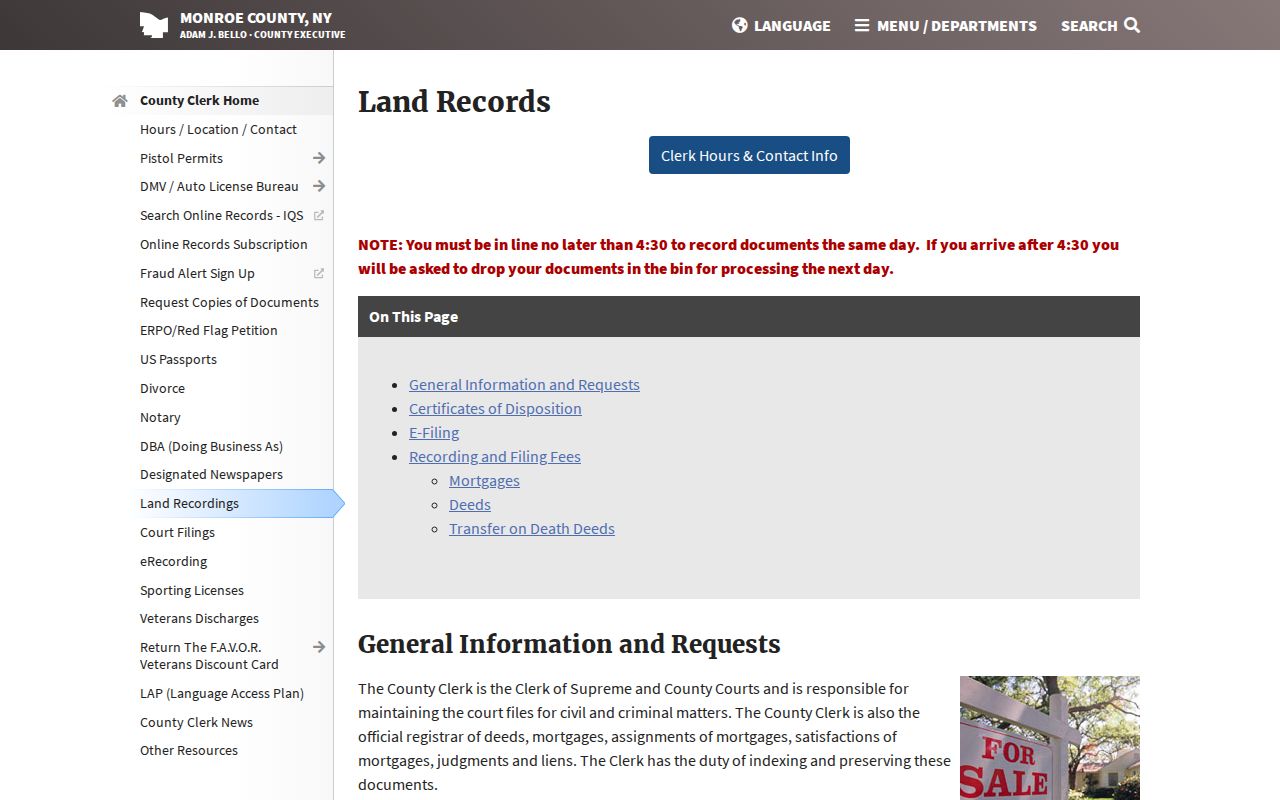
The image is a reminder to preserve both the discovery layer and the later copy or image route. A deed index points to a record; it does not by itself establish an occupant.
Note: The county reported no exact IQS subscription price in the official release, so confirm current image access before planning a Monroe records request.
Monroe Previous Residents Before 1975
For an earlier Monroe transfer, move to microfilm and index books rather than assuming an online search is complete. The historical deed guide directs researchers to the Downtown Filing Office, County Office Building, 39 West Main Street, first-floor Room 105. Select film by liber, locate the page, and use the transfer year plus the grantee surname initial in the index books when an older item lacks a liber and page reference.
The County Clerk is at 39 West Main Street, Room 101/105, Rochester. Public hours are generally Monday through Friday, 9-5; information is available at 585-753-1600 and customer service at 585-753-1620. The county also documents mail, fax, public counter, terminal, and copy-request channels. Before Monroe County existed, the Clerk holds microfilm for the relevant Ontario and Genesee County transactions. That predecessor-county step is essential for a parcel whose history reaches before 1821.
Trace the Monroe Deed Chain Backward
A chain of title is the sequence of recorded transfers tied to one parcel. In plain terms, a grantor transfers property and a grantee receives it. The Clerk's method is local and specific: begin with the oldest available deed, identify the earlier party and legal description, then search that earlier name as a grantee. Use the transfer year, liber and page, and land description to separate common names. A legal description is the lot, tract, or boundary language in the recorded instrument. It often survives when a street number does not.
- Copy the current parcel's situs address, SBL, municipality, and legal description.
- Find the present holder's purchase deed and save its document details.
- Read the prior grantor as the next earlier owner or seller to investigate.
- Search that person as a grantee, using the transfer year and description to confirm the parcel.
- Repeat backward, then move to microfilm, index books, or predecessor-county material when the online route ends.
- Grantor
- The party transferring an interest in a recorded deed.
- Grantee
- The party receiving the interest named in a recorded deed.
- Chain of title
- The dated sequence of transfers for the same property.
- Legal description
- The deed's land description, used to keep a historical transfer tied to the right parcel.
Mortgages, liens, satisfactions, maps, and judgments can add context. They do not prove that a named party occupied the address. Keep those documentary roles separate throughout a Monroe previous residents record trail.
Rochester Field Cards for Monroe Previous Residents
Rochester's field assessment cards are a rare bridge between the deed trail and the household trail. The Municipal Archives holds cards from 1927-1980 that can contain prior owners or residents, drawings, photographs, and assessment context. They are especially useful after a legal transfer has identified the parcel but before a directory or census has confirmed the household picture.
The Municipal Archives access page says there are no walk-ins. Begin with its Online Records Access Application, arrange a genealogy or research appointment at 585-428-7331, and ask whether the requested series is open before requesting names or address material. Copies are listed at 25 cents per page.
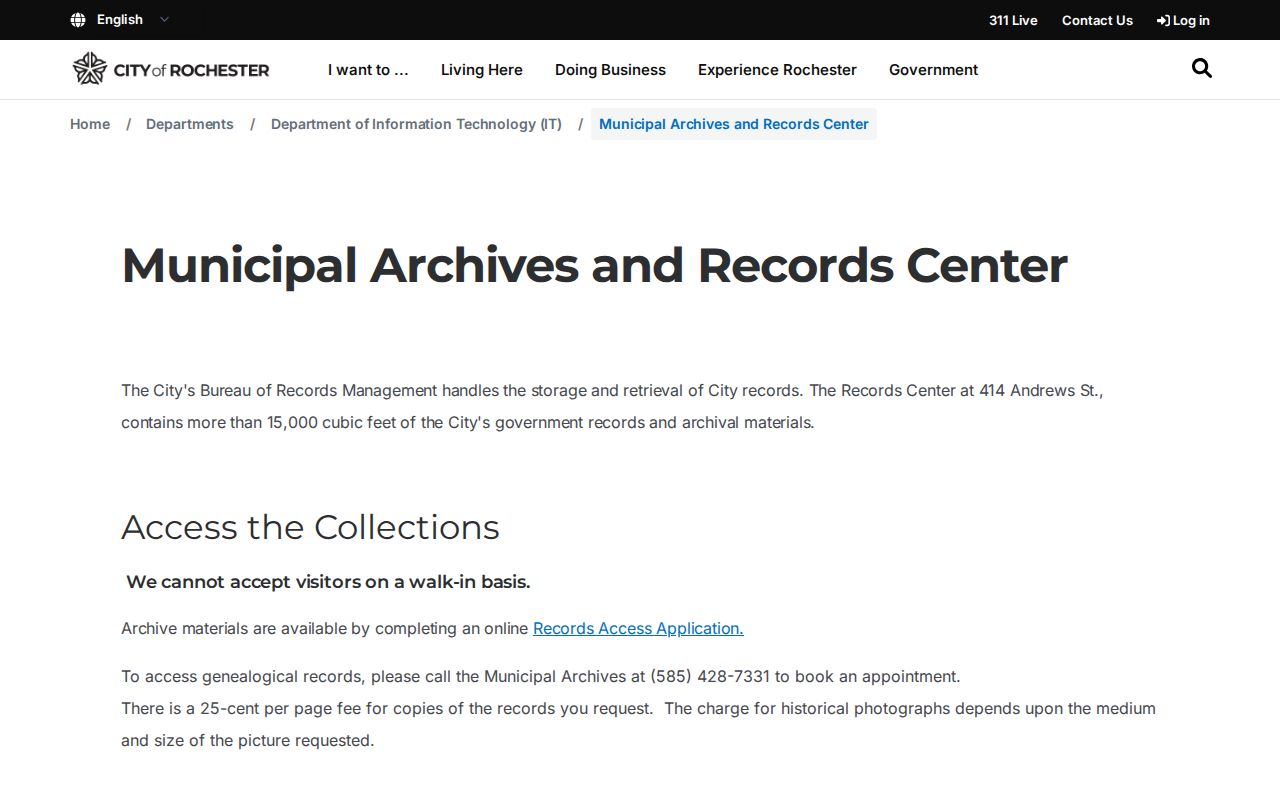
The archive view supports a careful request: give the street, former street spelling if known, parcel identifiers, and the narrowest date range. A field card remains a dated archival source, not a substitute for the recorded deed or a full household census.
Pair Monroe Previous Residents with Directories
Past owners are only part of an address history. RPL's Rochester City Directory collection begins in 1827, and the Rochester House Directory gives an address-first route for 1892-1920. From 1922, similar house-directory material is included at the back of the main directory. Pair a deed date with the nearest directory year, then compare the printed address, name spelling, and page with census and newspaper material. The Monroe city directory collections provide the detailed shelf and scan routes.
- Find the closest directory year to the transfer or event being studied.
- Check the address-first house volume or main-directory house section.
- Search the alphabetical section for each printed name and variant.
- Pair the dated listing with the nearest census and a newspaper or obituary notice when available.
- Mark the result as listed at the address, owned, received mail, or another documented role.
The Rochester Newspaper Index covers 1818-1897, while the library's Life Records descriptions contain differing date ranges. For the latter, treat the live database as controlling and check with RPL staff. A gap between sources may reflect an omission, a changing boundary, or a missing volume. It is not a license to infer a resident.
Old Monroe Street Names and Gaps
Street names and numbers can break an otherwise solid chain. Rochester's Register of City Streets covers openings, dedications, and name changes from 1834-1921. RPL's house-research guidance gives useful examples: St. Bridget's Drive was formerly Hand Street, Bronson Street later became Dr. Samuel McCree Way, and the building now numbered 561 State Street was 347 State Street in the nineteenth century. These examples show why a current address alone may fail in an older directory.
Use cross streets, neighboring numbers, lot or tract language, the 1872 original-lot atlas, local plats, and the 1911-1912 Rochester Sanborn volume to test an old address. County GIS Records also holds road and sewer drawings into the 1870s, as-built sewer plans from 1876, and aerial imagery from the 1930s. The research did not locate a comprehensive citywide renumbering schedule or a courthouse-fire loss for a particular Monroe decade. Record those gaps plainly.
Monroe Probate Clues for Previous Residents
Probate can help close an address trail when a deed or directory shows a final dated appearance. Monroe County Surrogate's Court has yearly public index links from 2012-2026, and WebSurrogate provides name, file, old-index, index-book, and will search routes. A probate index is estate evidence, not proof that a person resided at a particular property. Safekeeping wills are not public, and protected files stay protected.
The WebSurrogate search portal shows the available ways to locate a Monroe estate or historical index.
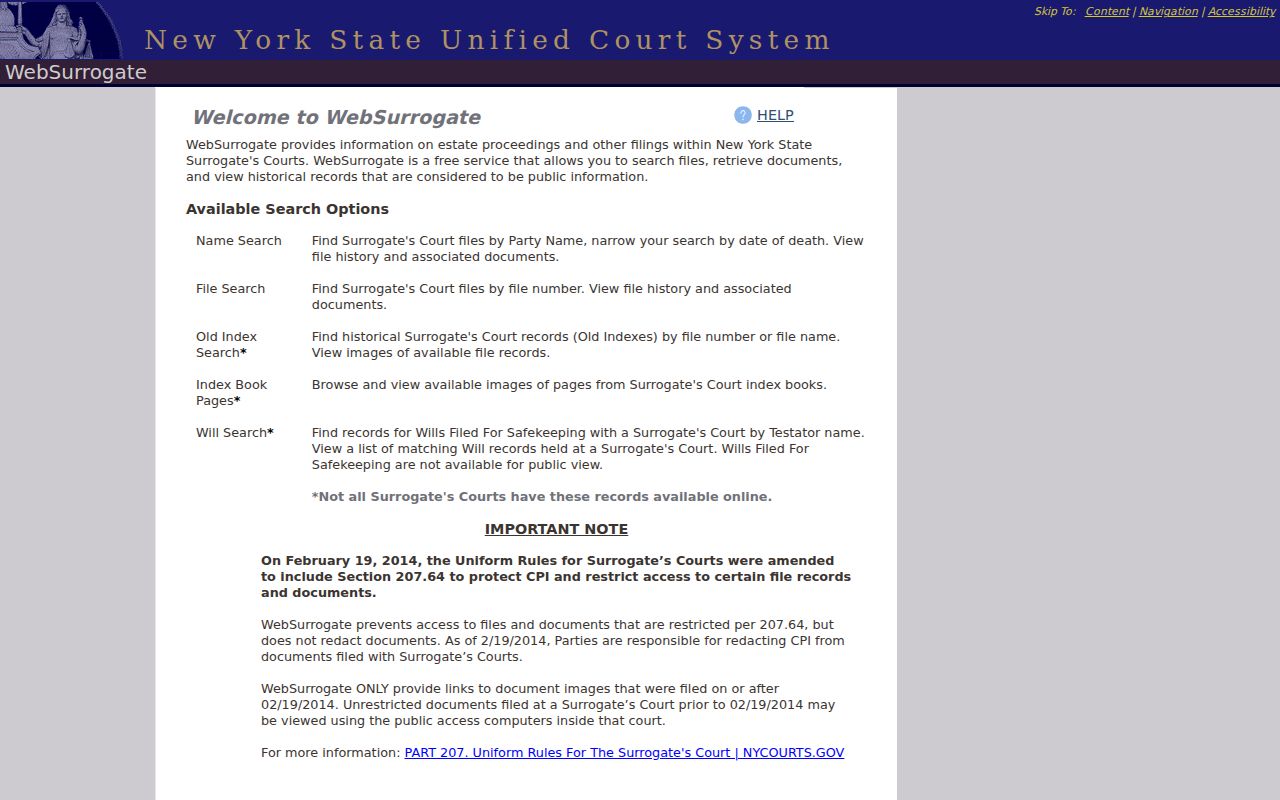
Online images generally begin with documents filed on or after February 19, 2014. Earlier images may require a courthouse public-access computer. For a formal file or copy request, use the appropriate court clerk route under Judiciary Law §255 rather than county FOIL.